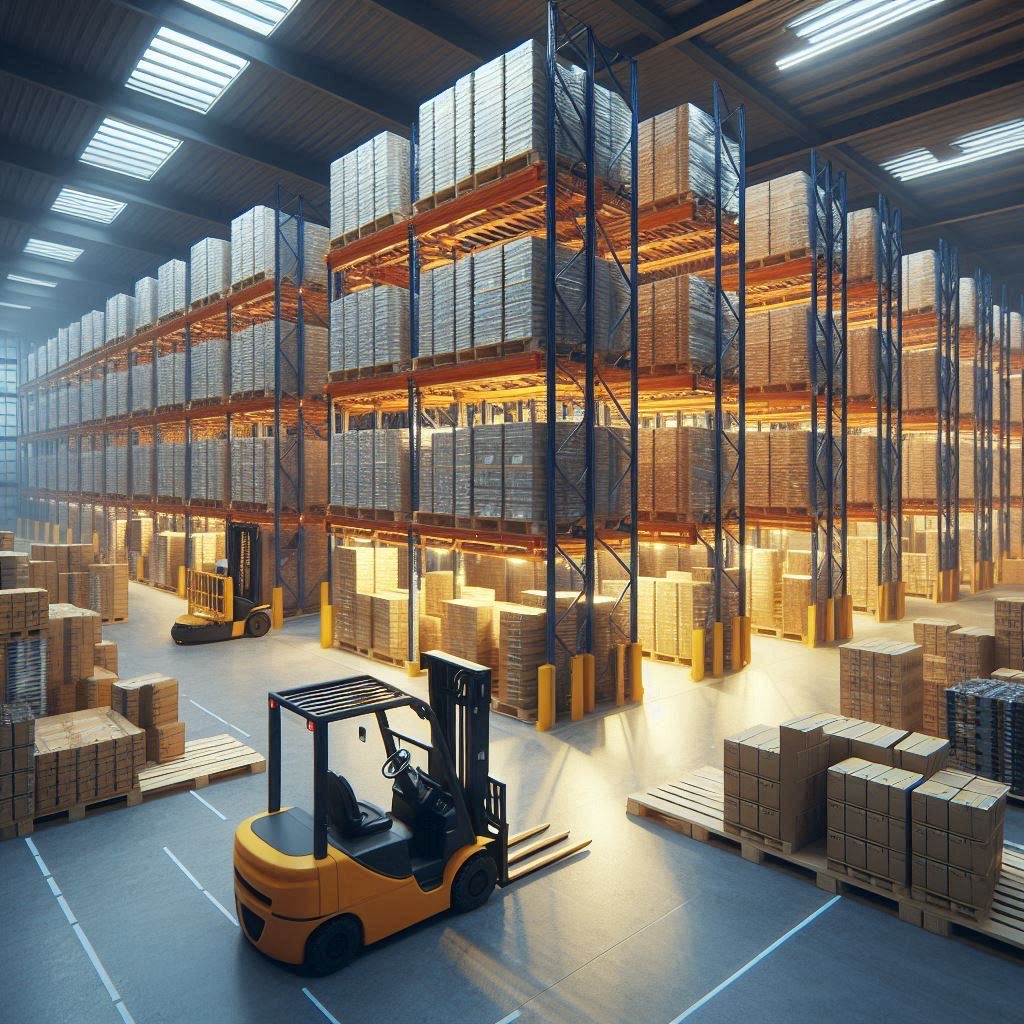
At Shelving & Racking Ltd, we have been supplying trade, business and industrial clients with pallet racking for over 35 years.
Whether you need a few spare parts or a full design and build for a large warehouse development, we can help and aim to make the process as simple as possible.
Use the form below or call us on 0113 539 5911 to get in touch with any details or requirements you have and we’ll do the rest.


A Brief History of Pallet Racking
Pallet racking has been a crucial innovation in the evolution of modern warehousing and logistics, transforming the way goods are stored, accessed, and moved. The history of pallet racking can be traced back to the mid-20th century, coinciding with the rise of mass production, global trade, and large-scale distribution networks. As businesses expanded, the need for efficient and scalable storage solutions became increasingly evident.
Before pallet racking systems, warehouses relied on stacking goods directly on the floor or using basic shelving units. This method was inefficient and took up a significant amount of floor space, which led to limited storage capacity. The introduction of the forklift in the 1920s was a pivotal moment for warehousing, as it allowed for easier movement and stacking of goods. However, a more organised, space-saving system was needed to accommodate growing inventories, which is where pallet racking found its niche.
The development of pallet racking began in earnest in the 1950s. This new storage system was designed to work in conjunction with pallets and forklifts, offering a way to store goods vertically. By making better use of warehouse height, pallet racking allowed businesses to dramatically increase their storage capacity without expanding their footprint. It also improved organisation, allowing for easier access to inventory and streamlined logistics.
One of the pioneers in the development of pallet racking was Dexion, a British company founded in 1937 by Demetrius Comino. Dexion is credited with developing one of the first adjustable storage systems, which became a template for modern racking. Their “slotted angle” system allowed racking to be easily adjusted to different heights, providing flexibility for businesses with varying storage needs. Dexion’s racking solutions became widely adopted throughout Europe and beyond.
Another major player in the industry is Redirack, which was established in the 1970s. Known for its robust and durable designs, Redirack specialises in heavy-duty pallet racking systems that cater to larger warehouses with high storage volumes. Redirack systems are particularly popular in industries that require the storage of large, bulky items or goods that need to be accessed quickly and frequently. Their drive-in racking and push-back systems have been instrumental in providing high-density storage solutions.
Link 51, founded in the 1950s in the UK, also played a significant role in the evolution of pallet racking. Link 51 quickly became one of the leading manufacturers of storage systems in the UK, offering a wide range of products, including selective pallet racking, which allows for direct access to every pallet, making it a popular choice for businesses with a high turnover of stock. The company has maintained its position as a major player in the industry through innovation and a focus on customisable solutions for various industries.
The design and technology behind pallet racking have evolved significantly over the decades. Today, there are various types of pallet racking, including selective racking, drive-in racking, push-back racking, and cantilever racking, each designed to meet specific storage needs. Advances in materials, particularly the use of steel and reinforced alloys, have made racking systems more durable, allowing for heavier loads and improved safety.
In recent years, pallet racking has continued to evolve with the rise of automated storage and retrieval systems (ASRS). These systems integrate technology with racking, allowing for faster and more efficient retrieval of goods, further optimising warehouse operations.
In conclusion, pallet racking has had a profound impact on the logistics industry. Companies like Dexion, Redirack, and Link 51 have been at the forefront of this evolution, providing solutions that have helped businesses maximise space, improve efficiency, and adapt to the changing demands of global commerce.
 Pallet Racking
Leave a comment